
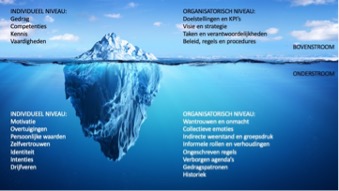
The terms “undercurrent” and “upper current” are often used in organisations and organisational psychology to describe organisational dynamics. The undercurrent refers to hidden, not always visible factors such as emotions, perceptions, beliefs, values and interpersonal relationships. The upper current refers to visible, measurable elements such as processes, structure, policies and formal communication.
The undercurrent has a considerable influence on the upper current and on how an organisation functions. Here is how:
Decision-making
The undercurrent, including prevailing beliefs and emotions, can influence organisational decision-making. Emotional responses such as fear or enthusiasm can affect the way decisions are made.
Culture
The undercurrent plays a crucial role in shaping organisational culture. Deeply embedded values, norms and beliefs influence how employees interact and which behaviours are encouraged or discouraged.
Motivation and engagement
The undercurrent can influence employee motivation and engagement. Positive emotions such as satisfaction and appreciation can improve performance, while negative emotions such as dissatisfaction or fear can reduce motivation.
Communication
Emotions and perceptions in the undercurrent can affect how employees communicate. They may create misunderstandings and conflicts, or support effective collaboration and feedback.
Resistance to change
The undercurrent can lead to resistance even when changes are rational and practical. Fear of the unknown and attachment to existing habits and beliefs can make change difficult to accept.
Leadership
Leaders are also influenced by the undercurrent. Their emotions and beliefs can affect their leadership style and decision-making.
Team effectiveness
The quality of team relationships is an important aspect of the undercurrent. Strong, positive relationships can promote productivity and collaboration, while conflict and distrust can hinder them.
Understanding the undercurrent is essential for leaders and organisations to function effectively and address problems. This requires empathy, effective communication and the ability to recognise and respond to hidden dynamics. A healthy organisation considers both the upper current and the undercurrent, balancing rational and emotional elements.